
Promotional products are no longer just about impressions or giveaways. In a market that keeps getting smarter, the brands that win are those that invest in staying power.
We often hear promotional products discussed as if they’re a volume game.
Conventional logic says that if you want promotional products to make an impact, it’s all about quantity over quality. The more swag you hand out, the more impressions you get, and in the digital age, that’s what matters most, right?
Except promotional swag isn’t digital, and that’s kind of the point. No one reaches for branded merch because they want a physical version of banner ads. They reach for it because it’s a useful item that improves everyday life in a way an on-screen impression never will.
With that in mind, measuring tangible marketing with digital metrics is like stepping on a scale and getting your weight back in inches. It just doesn’t work that way. That makes distribution alone a pretty limited way to judge promotional products.
That leaves a more interesting question sitting underneath all of this: what makes someone keep a promotional product in the first place?
The True Price of Cheap Swag
We’ve talked before about a TBK Promotions-branded dry bag that resurfaced a decade later, and it really exemplified the #1 rule about logo gear: The handoff is the least interesting moment in the object’s life.
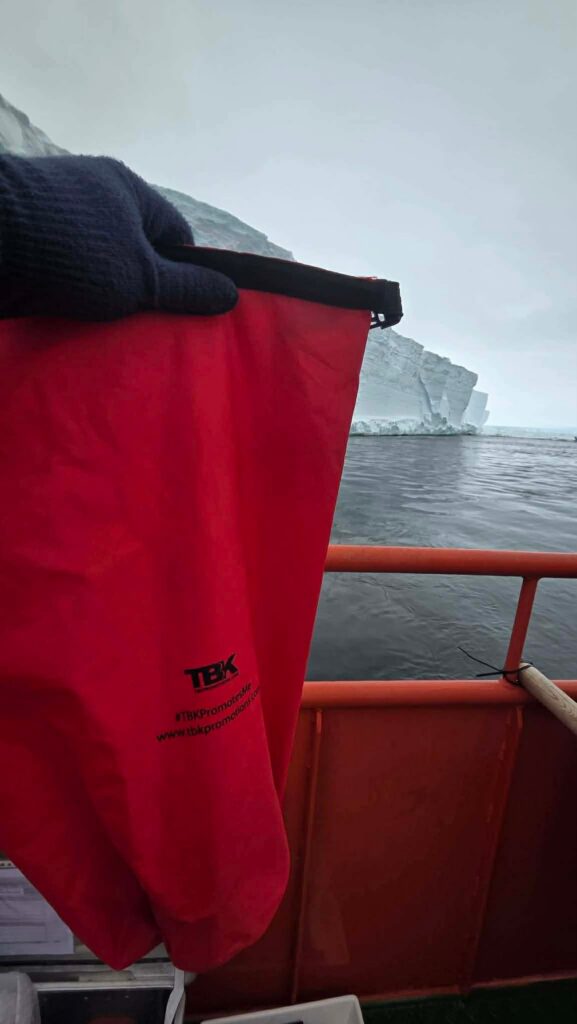
What matters is everything that happens afterward, and the fact that, long before that bag made it anywhere near subzero biomes, someone decided not to throw it away. Then they decided to keep using it. Then, eventually, they decided it was rugged enough as a piece of gear to take to one of the world’s harshest environments.
Nobody carries a dry bag to Antarctica out of loyalty to someone’s marketing campaign. They carry it because, over time, it has managed to justify its place among the small number of things worth bringing along on such an expedition.
That is the true price of cheap swag. Whatever you save upfront, you usually pay for later in the compromises that made the item cheap in the first place. Maybe it’s flimsy. Maybe it’s made from cheap materials. Maybe it feels overly generic or too aggressively branded. Whatever you save in cash, you’re paying for in a lack of long-term, positive brand impact.
Not sure if branded gifts will give you the ROI you’re looking for?
Get insights into the relationship between custom marketing gifts and brand visibility.
5 Criteria That Separate Cheap Swag From the Good Stuff
So, we have the answer to the original question. The best metric for measuring promotional product ROI is whether an item stays in someone’s life long enough to leave a positive impression of your brand. That answer naturally leads to the next question: What actually makes swag high-value in the first place?
It Has to Displace Something Else
Your audience already owns a tote bag, water bottle, notebook, charger, or umbrella, so your branded version is being judged against the one they already have at home. That raises the bar considerably, so your giveaways need to be an upgrade, or at least like a version worth reaching for over whatever they already have on hand.
It Has to Survive the Loss of Novelty
Almost any free item gets a brief honeymoon period, during which the recipient may even use it once or twice. That early contact can be misleading because it says more about the conditions of the handoff than the quality of the product itself. Once the novelty wears off, the item has to stand on its own as something worth using, without the social obligation or curiosity the event created around it.
It Has to Justify the Space It Takes Up
Physical objects face a much stricter test than digital impressions because they have to earn room in someone’s home, instead of a spot on someone’s infinite feed. A product can be mildly useful and still fail here if it is bulky, redundant, awkward to store, or only relevant in rare situations.
It Has to Make the Brand Look Better
One of the steepest costs of cheap swag is brand perception. The moment you put your name on something mediocre, you tie your brand to that experience of disappointment.
It Has to Keep Proving the Decision Right
What makes the dry bag example so compelling is that the product kept justifying the choice to keep it across an entire decade. Every reuse confirmed that it was still worth hanging onto, which cultivated lasting value and hundreds, if not thousands, of impressions.
Make Your Mark With High-Value Promo Products
Let our team of promo experts help you craft the perfect branded swag strategy.